Showing posts with label Middle East respiratory syndrome. Show all posts

Friday, September 19, 2014

MERS risk reduction and signs of illness to watch for during hajj and umrah...

I love a good infographic and this one ticks a lot of boxes for getting a clear message out about the Middle East respiratory syndrome (MERS) disease and how to avoid catching and spreading the MERS-coronavirus (MERS-CoV).

Thanks World Health Organization.
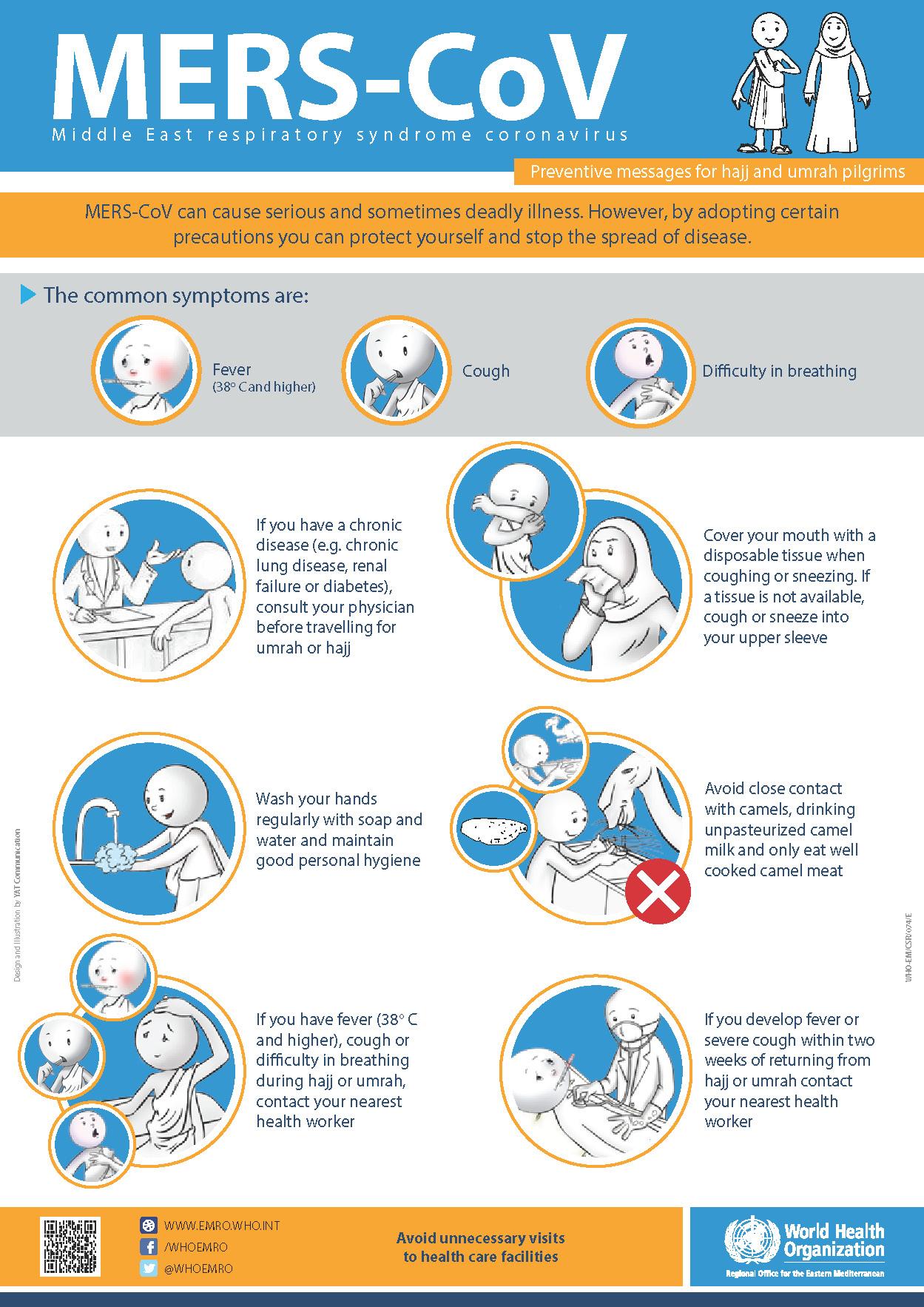

World Health Organization poster describing risk of infection
 and how to identify when you might have MERS.
Of course, I'd be happier if the poster specifically suggested putting more distance between people and potentially infected camels, rather than just avoiding "close contact".

Granted, close contact can include spending time in the close, but not physically connected, "personal space" of a camel. But "close contact" is, in my opinion, one of those infectious disease terms that needs to be made more simple and clear. Like "aerosol" and "airborne", "close contact" gets a little lost when translated to the people who are at actual risk from infection.

Sunday, September 14, 2014

Happy 2nd birthday Middle East respiratory syndrome coronavirus (MERS-CoV)...

Its been 2-years since Prof. Ali Mohamed Zaki sent his email to ProMED notifying them of a novel coronavirus. That email was published 20-Sept 2012.[1] 

A year ago we had 138 cases and 58 deaths. Today we have 856 cases with perhaps 306 fatal (36%).

I won't rehash what I said a year ago - I invite you to check that out over at the 1st birthday post.[2]

Suffice to say the past year has been, to my mind anyway, mostly about:

  • Camels
  • High level job "shuffling"
  • Controversial parallel publications
  • Very problematic infection prevention and control issues.
The latter leading to the relatively huge number of MERS-CoV detections and deaths in Saudi Arabia and to some exported detections and cases. The one constant over both years has been that the MERS-CoV is a pitiful spreader among humans. MERS-CoV is nonetheless a virus that is very capable of inducing fatal outcomes, especially among older males with underlying diseases.

Has MERS-CoV gone away? No. Of course it hasn't. MERS has, mostly. That's the disease, not the virus. For now anyway MERS cases are sporadic, although still geographically widespread. 

MERS cases fell to zero cases per week for a number of weeks this year following containment of the Jeddah-2014 outbreak. Nonetheless, this is a virus of camels that seems to  spread, rarely, to humans and when in us, it has not been in any rush to mutate into the pandemic SARS-like threat many once worried about. 

Camels are where this virus likely remains. And there have been no signs that that has in any way changed. The latest information suggests camels have been harbouring MERS-CoV for at least 30-years.[3] This, as with a great deal of the research to date, is knowledge gained mostly thanks to the efforts of international research teams and their funding

So Happy 2nd Birthday you opportunistic, spiky little killer. I'm once again wishing Dr Zaki well and congratulating him on co-parenting the birth of this novel coronavirus. This year I also wish Prof. Ziad Memish well and congratulate him on seeing the infant virus through to toddler age.

Oh, and 2-years on, I still see no sign that the contentious patenting issues were any sort of hindrance to diagnostics or actual research. Just sayin'.

References...

  1. http://www.promedmail.org/direct.php?id=20120920.1302733
  2. Happy 1st birthday Middle East respiratory syndrome coronavirus (MERS-CoV)http://virologydownunder.blogspot.com.au/2013/09/happy-1st-birthday-middle-east.html
  3. MERS Coronavirus Neutralizing Antibodies in Camels, Eastern Africa, 1983–1997
    http://wwwnc.cdc.gov/eid/article/20/12/14-1026_article

Tuesday, February 4, 2014

Middle East respiratory syndrome coronavirus (MERS-CoV): summing up 100 weeks

We stand at 182 cases with 78 deaths. The proportion of fatal cases (PFC) stands at 43%.

  • Median age of all cases, including deaths, sits at 53-years (missing data on 13 cases); median age of fatal cases is 60-years
  • 47% of all MERS cases with data are >55-years of age; 36% are >60-years
  • 65% of cases are male (missing data on 18 cases)
  • Underlying comorbidities feature in most severe disease MERS cases
  • Approximately 18% of MERS-CoV cases are in healthcare workers; 2.7% of all fatal MERS cases are HCWs
  • 81% of case are from the Kingdom of Saudi Arabia (KSA); the Arabian peninsula is the zone of case origin
  • Reliable real-time reverse transcription polymerase chain reaction (RT-rtPCR) assays exist for detection, confirmation and genotyping
  • Camels have been found on multiple occasions at multiple sites in the region to have antibodies to an antigenically similar virus to the MERS-CoV and nasal swabs have been found to be MERS-CoV RNA positive, as have humans in contact with the same camels (infection direction unknown). 
  • Camel, goat, monkey, alpaca and human cells lines efficiently replicate MERS-CoV (multiple intermediate sources?)
  • 1 diagnostic sequence of MERS-CoV RNA has been identified in a Taphozus perforatus bat (origin of animal other infections?)
  • MERS-CoV uses DPP4 (CD26) as its receptor on host cells, a molecule found on some cell lines and epithelial cells of kidney, small intestine, liver and prostate. DPP4 has a standard role in hormone and chemokine activation
  • No viable antiviral therapy or cocktail exists to treat infection. No vaccine exists.
  • MERS-CoV replicates well in the lower respiratory tract of lab-infected macaques
  • Person-to-person (p2p) transmission of MERS-CoV is sporadic
  • Genetic variation among MERS-CoV genomes suggests multiple insertions into humans from the source(s)
  • Fever, cough and shortness of breath in >70% of 47 cases in KSA; runny nose in 4%; abnormal chest X-Ray in 100%
  • Sample often, sample lower respiratory tract to increase chance of successful RT-PCR result 
  • Testing 5,065 hospitalized patients, healthcare worker contacts and family contacts found 2% (n=106) positivity over 12-months, in Saudi Arabia 
  • MERS-CoV has circulated in KSA during several mass gatherings (2x Hajj pilgrimages and Umrah) providing ample opportunity for p2p transmission. There has been no evidence for an uptick in p2p transmission. We are nowhere near the verge of a pandemic.

Tuesday, September 3, 2013

How MERS may be SARS, but we don't really know

On July 26th, Prof Christian Drosten wrote in Lancet Infectious Diseases about some similarities and differences between the diseases Middle East respiratory syndrome (MERS) and severe acute respiratory syndrome (SARS), each linked to a zoonotic coronavirus (CoV) infection.

Drosten is senior author of the 2 publications papers describing gold-standard MERS-CoV laboratory diagnostic methods, all PCR-based, which afford excellent diagnostic and genotyping capabilities upon the user. Unfortunately we have not yet seen much use of the genotyping assays. He has also co-authored papers on the MERS-CoV receptor, viral replication, its naming, discovery of antibodies in camels and MERS case reports. He has an even bigger list of diverse publications on the SARS-CoV.

Drosten is well positioned to say that at first glance it is not the same beast but that we have many things to learn before we can be sure of that. 

Reviewing data from Assiri and colleagues from the same issue of Lancet, he noted that MERS and SARS have some similarities. Cases often presented with fever as a classifying symptom at presentation. Upper respiratory tract symptoms were not common (4-40% of cases had something that could identify an upper airway disease) and so most cases could be clinically differentiated from the common cold.

A major difference from SARS has been the high level of comorbidities associated with MERS cases. However, this needs to be interpreted with caution since for example, a third of people in a pre-MERS study of Saudi Arabian outpatient visits had diabetes, including more than half over the age of 50-years. In that context, the proportion of MERS-CoV positives among his group in the Kingdom of Saudi Arabia (KSA) population may not be so over-represented. It may simply flag the opportunistic nature of the virus. 


MERS also differentiates itself from SARS in its rapid progression to a fatal outcome; again this may be related to the population it is affecting the most; older males with comorbidities. Mechanistically, MERS-CoV differs in its cellular receptor (DPP4 vs ACE2 for SARS-CoV) and its greater replicative efficiency and ability to infect a wider range of cell types in the lower airways compared to SARS-CoV. And then there's the spelling, nucleotide and amino acid sequence differences too!


Drosten also poses some questions: 
  1. Can we rely on samples from the upper respiratory tract in which viral loads can be low enough to muddy the waters of result interpretation?
  2. We need serological assays and we need to define them using characterized cases. Then we need to roll them out at the population level to better define those icebergs that seem to be everywhere these days
Without further data, we're still left to ponder what would SARS have been like if the CoV got into the KSA? In fact, what do other respiratory viruses do to those with comorbidities in the KSA?

There are similarities and differences between MERS and SARS and between their viral causes. More work is needed. 

The best way to answer the question posed in Drosten's article would have been a direct comparison of the impact of the two viruses in the same population. Thankfully for the hosts, there has been no significant overlap between the 2 outbreaks so far.