Showing posts with label airborne. Show all posts

Friday, September 12, 2014

The wind beneath my Ebola virus.... [UPDATED]

Only a couple of weeks ago the report in Science presented 99 genomes representing some of the thousands of those circulating in Sierra Leone this year.[1] I say thousands because each infected person has a range of subtley different viral variants among the billions of viruses per millilitre of blood that all compete to be the champion. The words "mutant" and "ebolavirus" are now hard to avoid. And of course as soon as you talk mutations, you can only see one endgame - a virus that is easily transmissible and turns us all into zombies. spreads across the world in a pandemic and kills as many as 80% of those it infects. Yes, its seems the proportion of fatal cases (PFC) in West Africa may not be as simply calculated as most of us were thinking these past months. When we take into account that Ebola virus disease deaths occur in people that were part of a case tally days earlier (if they were counted of course) when the total case numbers were smaller, the PFC inflates. How much, we don't really know.

And so the story of mutants was brought full circle today thanks to Dr. Michael T. Osterholm. In a very nicely written piece for the New York Times,[2] Dr. Osterholm, ventured behind the scenes to crack the door into the world of whispered discussions, shadowy frappé meetings by chino and beige blazer-wearing figures, many of whom were men with with thinning hair. Yes, he found where the real virologists hang out and what were they discussing at length? Why they were talking about how soon it would be until Zaire ebolavirus was going to mutate and become an airborne killer virus identifiable only through watching big wall-mounted LCD screens as they are rendered in red because of the fusion of rapidly growing dots, spreading across a map of a world filling rapidly with infected hosts. Or red dots. Or something. Okay, some of that was from me.


Only problem is, I think he may have entered the tinfoil hat room next door to the (but very similarly attired) room full of virologists. Maybe not. Hard to tell sometimes. But seriously.


For sure, a virus changes over time. It will change randomly through mutations that happen because viruses, especially those with genes/a genome made of RNA, are always making errors in their gene/genome copying and sometimes those errors make the virus better at something. Viruses may hold on to those changes in response to all sorts of pressures on them. These genetic sequence changes sometimes results in change to the proteins that make their structures and enzymes. Sometimes the changes may revert back as pressures go away or new ones come to be. It's a constant micro-environment of change; evolution on fast forward.


We should also keep in mind ebolaviruses didn't come down in the last shower. They are viruses that are happy in their own envelopes...and natural host(s). But mutational changes can impact on how the viral "bits" assemble and release from the cell and perhaps on how the virus causes disease, where virus replicates in the body, how it interferes with the host immune system's attempts to interfere with it, how hardy it is, how well it replicates in response to temperature and so on. 


A virus doesn't "think" about any this of course. It doesn't plan to do the nastiest thing to us that we can imagine when it jumps into us from an animal (a zoonosis). Headlines might make you think otherwise. These changes happen because, in a new host species producing many subtley different viral variants all vying for supremacy, the virus with the mutation(s) that allow it to get out from under some sort of controlling pressure or to do something better than the earlier viral versions, wins the day. The winner thrives, makes more of itself or does it better, and passes to new hosts.


A virus may keep more of these mutational changes while it is "settling in" to a new animal host species if they help that process. It may be under more pressure to adapt to slightly different environments, different receptor structures, temperatures, immune responses - all sorts of things may created a different environment from the one the virus came from and so it may need to make use of more mutations in order to "find its footing". Or fail and not find a home in the new host.
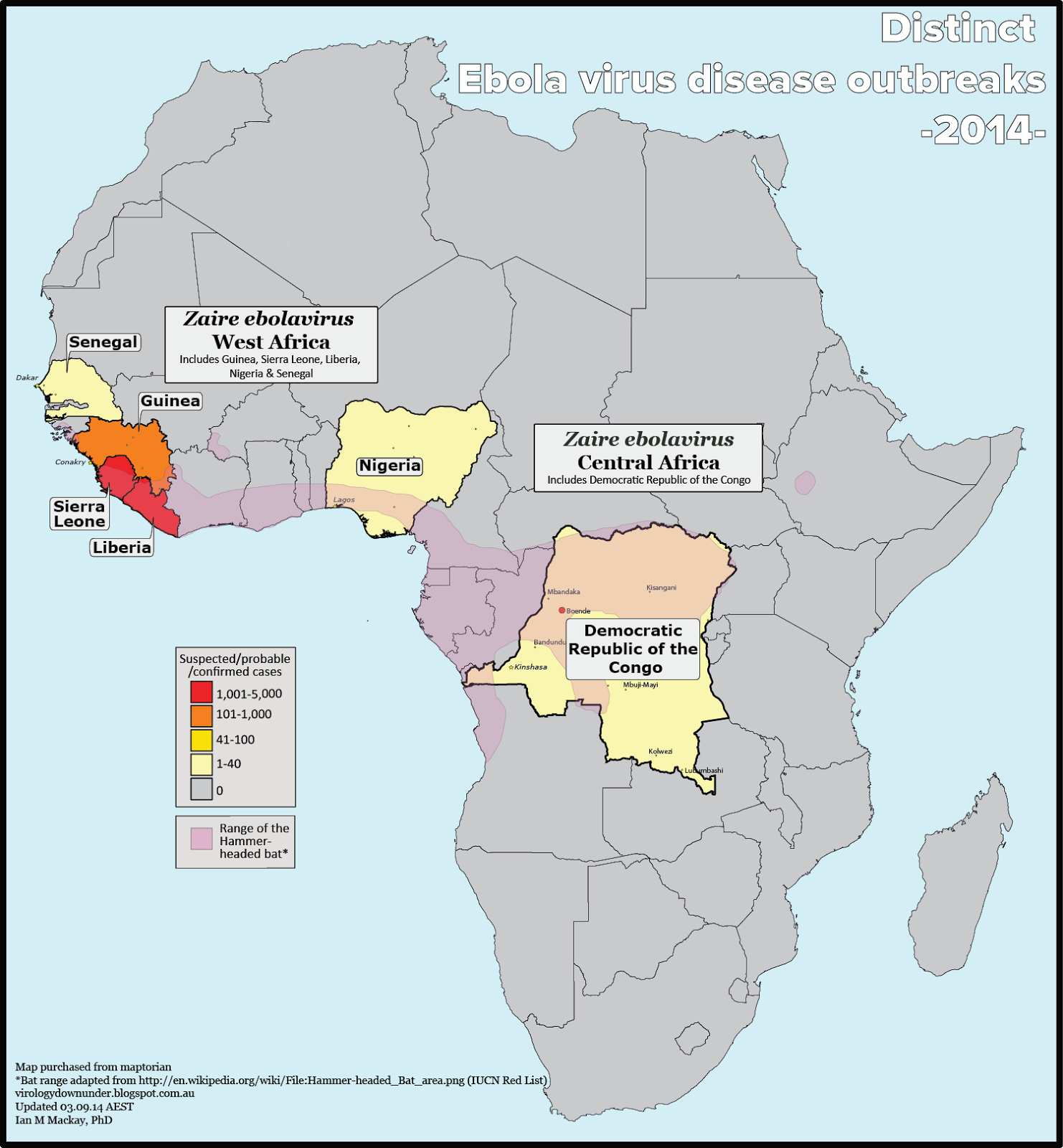

There can be all sorts of new and negative pressures to try and avoid or adapt to for a virus. So ebolaviruses seem to naturally infect bats, not us, and in bats the infection does not seem to cause a whole lot of disease. Of course we don't know a whole lot about how bats spread virus among themselves. Perhaps they do it via an airborne route. The theory then goes that humans or other forest animals including chimpanzees, gorillas, porcupines and antelopes may eat the bats or bat/virus-contaminated fruit. We, and those animals, do get sick.


Another unsure thing, a sizable knowledge gap you might call it, is whether an ebolavirus would actually be under any pressure at all to keep the mutations that change its proteins, site of replication and disease course which result in it being:

  • More stable in dried droplets
  • Shed in higher concentrations from the upper respiratory tract
  • Able to trigger more coughing or sneezing.
Each and all of these major changes might be necessary to create the mythical airborne Ebola virus. The outcome? Creation and propulsion of more droplets from an infected human, that dry down and linger in the air (the airborne part) while still containing infectious ebolavirus, and enough of it to result in human infection and disease. Phew. That is an unbelievable series of huge changes, even for a "sloppy" replicating RNA virus. 

I think we all understand that a virus doesn't "know" that these changes would provide better spreading outcomes and we now know that Ebola virus already spreads very well between bats and in humans (see the West Africa outbreak numbers which have not at any time been linked to a different or unusual spread of virus compared to any earlier outbreak[11]). To date, airborne spread has never been found to happen naturally in the dissemination of Ebola virus disease in humans. That is some kind of significant considering it does not take a lot of virus to start an infection through direct contact and considering there have been non-human primate transmission chains in the forests for a long time.

Each of those changes to the virus and the host's disease might happen by a series of accumulating mutations over time. But is their pressure to keep each of them? And really to be airborne, these changes would need to co-occur and do so without any trade-offs that meant the 'new airborne virus' was negatively impacted in some other area of its attachment, cell entry, replication, interference with the immune response enzymatic efficiencies etc. 


We do already know that in the lab, under laboratory conditions, with lab animals, lab equipment, plenty of lab-grown virus and a closed space with a lot of aerosol (probably some of which is wet droplets, not just droplet nuclei, meaning not truly airborne conditions), an Ebola virus can be forced to infect non-human primates. I've written about that previously.[3] 


And yet even when it was sought, no sign of such airborne infection has been found to occur naturally among humans. Direct. Contact. 


So I think it was a stretch to expend so many words on the chances of an airborne virus emerging rather than one that causes more bleeding, or less diarrhoea, or more vomiting, or more shedding in sweat, or having lower viral loads, more rash, more hiccups etc. 

Many additional things could result from mutational changes. We know next to nothing about the mutations recorded from the 99 genomes in Sierra Leone.[1] So why all this focus on one specific yet really quite complex outcome of viral air travel instead of many/any others? I don't know. But hey, now we have indeed been able to talk about this aspect some more, so good one Dr O! 


Others have come out to comment too. 


  • Dr Anthony Fauci, director of the National Institute of Allergy and Infectious Diseases in the US noted that "it’s fundamentally unlikely"[9]
  • Dr Amesh Adalja, University Pittsburgh said "it may not be the best path for the virus to take"[10]
  • Dr Derek Gatherer of Lancaster University in the UK noted an airborne Ebola virus would need a "conjunction of coincidental, unlikely events" [10] 

  • Dr David Heymann, Chair of the Health Protection Agency in the UK stated "No one can predict what will happen with the mutation of the virus", reminding us that "The virus's epidemiology is consistent with transmission via bodily secretions and excretions, which is exactly the same as other past epidemics".[11]
  • Prof Vincent Racaniello, a virologist at the College of Physicians and Surgeons at Columbia University stated "We have been studying viruses for over 100 years, and we've never seen a human virus change the way it is transmitted."[12]

Dr Osterholm did hit some other nails flush with the timber though. West Africa needs fewer promises to defeat Ebola virus and more plans that include actual rapid mobilization and on the ground experienced leadership to make inroads into getting beds for sick people and tracing contacts. Two key items on a long list of things to do better (in my opinion).

Thankfully some promising signs are appearing. The scope of this outbreak has now been guesstimated - 20k-100k cases.[4,5,6,7] I list this range rather than extending it to much higher levels [8] because I do still have hope that things will improve and interventions will turn the exponential case growth curves away from the sky and back to the horizon, sooner rather than before entire nations are destroyed. Because that's what is coming without successful intervention.


Money is being freed up and arriving from all over and more resources are slowly moving in to the region. Resources needed just to keep the people safe who have come from all over the world, including the nations of Africa, to care for the overwhelming numbers of sick and sickening people. Not to mention the money needed to prevent more infections. More specific and insistent pleas for defined numbers of healthcare professionals are also being broadcast. Drugs and vaccines are closer than they have ever been to use in humans. They may be our only hope to stop this virus.


If the many thousands of people predicted to die from a virus that is killing 4 in 5 confirmed cases (see the Medicins Sans Frontieres tweet below) is not enough reason for stopping the spread of Ebola virus, then stopping this particular evolving variant before it does change into something worse or more ingrained to the communities all over Africa and beyond, really is. 


While this Ebola virus variant may never make the changes necessary for it to go airborne, it has shown signs of relatively rapid change and that was relatively early in what looks to be a very long chain of human-to-human-to-human-to-human... transmission. Each person allowing the virus to adapt further, if that's what it needs to do.


Such a long transmission chain, from 1 animal>human infection, has never been recorded before and so we are indeed in new territory when it comes to the ebolaviruses. For now at least, the Ebola virus in 5 countries in and around West Africa has the upper hand. This tiny self-assembling unthinking, randomly mutating thing is totally dependent on our cells to replicate itself - and we are not doing enough to starve it of those cells. 


It clearly doesn't "need" to be airborne to spread efficiently.


References...
  1. http://www.sciencemag.org/content/345/6202/1369
  2. http://www.nytimes.com/2014/09/12/opinion/what-were-afraid-to-say-about-ebola.html?smid=tw-share
  3. http://virologydownunder.blogspot.com.au/2014/08/ebola-pigs-primates-and-people.html
  4. http://currents.plos.org/outbreaks/article/estimating-the-reproduction-number-of-zaire-ebolavirus-ebov-during-the-2014-outbreak-in-west-africa/
  5. http://currents.plos.org/outbreaks/article/obk-14-0036-early-epidemic-dynamics-of-the-west-african-2014-ebola-outbreak-estimates-derived-with-a-simple-two-parameter-model/
  6. http://healthintelligence.drupalgardens.com/content/predicting-number-cases-ebola-virus-disease-outbreak-countries-widespread-and-intense
  7. http://news.sciencemag.org/health/2014/08/disease-modelers-project-rapidly-rising-toll-ebola
  8. http://www.dw.de/ebola-threatens-to-destroy-sierra-leone-and-liberia/a-17915090
  9. http://time.com/3342305/airbone-ebola-not-happening/
  10. http://news.yahoo.com/could-ebola-become-airborne-153701091.html
  11. http://www.dailymail.co.uk/health/article-2753421/Real-risk-Ebola-virus-mutate-AIRBORNE-disease-expert-warns.html
  12. http://www.vox.com/2014/9/19/6543157/ebola-is-unlikely-to-go-airborne

Sunday, August 17, 2014

Ebola, pigs, primates and people

This is a companion piece to my collaborative article, Ebola virus may be spread by droplets, but not by an airborne route: what that means, posted a couple of days ago. I suggest you read the both together.

In this post, I'd like to make sure we all understand that an airborne route of Ebola virus infection has been used to deliberately infect non-human primates (NHPs). It is possible and it can be done. Okay? I'm not covering up any secret knowledge or trying to conceal facts that only we few evil-society-of-science types know. I don't secretly work for an agency aiming to delude you dear readers into feeling falsely safe about the risks associated with being near an Ebola virus infected person (which most reading this will likely never be). Frankly, I'm learning this as I go.

Don't expect perfection from risk mitigation advice.

Like all things that involve biology, there are hardly ever clear-cut lines and yes or  no definitions and explanations. Sometimes that's because things vary...because biology! Sometimes that's because we haven't yet done enough science to know those answers. I'm not an expert on ebolaviruses nor on Ebola virus disease (EVD) - but in my time learning about the viruses and the disease, its clear that this is (yet another) area that is lacking in all sorts of information. So risks are judged using what we do know and can support and verify, with softer language used when decision makers don't know for certain; less so when they think they do. 

When that message of risk gets passed to the public, it is important to be accurate, clear, concise but not to over-simplify things because that may degrade trust in the body(s) sending the message if things change later. That's a very tough balance when dealing with biological risks.

So having said that, let's talk pigs.

Pigs are not primates.

In ebolaville - the virtual world created by social and mainstream media stories and discussion about ebolaviruses - a lot of people have been throwing the 2012 pig to macaque study (8) around as an argument for why we should admit that ebolaviruses spread by an airborne route and run for the hills. This is why that is not a good comparison:
  • Pigs have a different disease and replication process to humans. 
    • Pigs tend to have much more virus growing in their lungs.(12) 
    • Pigs tend to cough and sneeze and generally propel more of said pathogen from their lungs.(11) 
  • Pigs may eject more infectious viruses in their droplets than do primates
If we look at the study of disease occurrence and spread in previous outbreaks, that epidemiology does not suggest an airborne spread - the numbers and nature of human-to-human spread don;t show it as any sort of major contributor to spread. Might it be a minor contributor? Possibly. We don;t know either way with 100% surety. But we do  know some other things. One of these is that it takes very little virus to infect pigs and NHPs. If there are not obvious signs of an airborne spread in humans, we just not have detected it yet or, it may have a biological basis. It is possible that the infectious dose (amount of virus needed to get a foothold and start an infection) may be much higher for humans; infected and severely ill human cases may not breathe out infectious virus or ebolaviruses may not survive for long in the aerosols expired by humans,(19) even if they can survive on hard surfaces or in generated aerosols under laboratory conditions.(20)

Non-human primates can be infected with ebolaviruses via a lab-made aerosol with lots of lab virus at lab temperatures and lab humidity and other lab conditions in a lab.

You get that this is done in a lab? Cool.

It apparently does not take much virus to infect a human via an aerosol according to the Public Health Agency of Canada's (PHAC) Pathogen Safety Data Sheet (PSDS) on ebolavirus.(1) Only 1-10 infectious organisms (see above). But one problem with that PSDS is that it cites only 1 paper to support that range. Ref 21 from the PSDS is entitled Clinical recognition and management of patients exposed to biological warfare agents.(2) It is 1997 review that does not specify if this range is specific to any 1 or more of the ebolaviruses, just "viral hemorrhagic fevers". The PSDS seems to rely on that 1 line. In that reference, there are no further links to studies that define this range for humans, ebolaviruses or an Ebola virus (EBOV) of the species Zaire ebolavirus. I've sent a couple of emails in the past week, seeking further clarification from ebolavirus experts, but have yet to hear anything back.

In a laboratory experiment reported in 1995, transmission of an EBOV from one set NHPs infected by injection, to another set  resulted in 2 of 3 NHPs (1 with a heavy load of virus in the lung) becoming infected and that seemed to have occurred through some kind of airborne route as the 2 groups of animals were separated by 3m and care was taken to avoid creating bigger droplets and splashes during cage cleaning.(15) While the authors noted that fomites (contaminated objects and surfaces) or contact droplet transmission of virus was unlikely, the exact mode of transmission to the second group of NHPs could not be determined. In a follow-up study, the authors were able to prove that conjunctival and oral exposure to an EBOV could indeed result in infection in NHPs.(18) Thus we have plenty of reason for the use of masks, goggles and face shields that are already part of the recommended personal protective equipment (PPE) items for dealing with infected humans.

However, there are a number of issues related to forced aerosol infection of NHPs, many of which can be found in a massive and detailed 2008 review by Dr. Jens Kuhn.(3) These include:
  • Often unrealistically high viral loads - the exact amount of infectious virus humans are exposed to during outbreaks has not been defined.
  • Temperature and humidity conditions that were unlikely to reflect conditions during outbreaks in Africa - but may reflect conditions in hospitals.
  • An initially lung-focussed pattern of viral replication (7) results from direct aerosol delivery of virus to NHP airways which seems different to infection of humans via the more frequent natural direct contact route. Systemic spread to multiple organs then follows via infected dendritic cells and macrophages and blood monocytes.
  • Different routes of virus acquisition can lead to different incubation periods.
  • Different virus isolates, sources and preparations may affect the course of infection and disease
  • Because of the small and enclosed space and air throughput in head-only chambers, droplets rather than droplet nuclei may be the vehicle carrying infectious virus. This is important because, as you can read in the companion piece, droplet nuclei are the component of a lingering "airborne route" of acquisition and if NHPs are in fact infected by the droplets, that may be more indicative of direct fluid contact than true airborne travel.
A head-only inhalation chamber of the sort used in NHP
aerosol inoculation studies. Biaera Technologies.
Image from http://www.biaera.com/our-technology/peripheral-
aerosol-instruments/head-only-chamber/
. See also (17)

Click on image to enlarge.
Some NHP studies that have successfully caused initial respiratory infection using an airborne route to infect NHPs under controlled experimental conditions include the following:
  • 1,000 plaque forming units (PFU; a measure of how much virus is in a preparation using cell culture methods in the lab) of either a Kikwit EBOV isolate or a Boniface isolate of Sudan virus (SUDV; species Sudan ebolavirus) isolate were delivered using a Collison nebulizer (producing small droplets) after intramuscular immunization with a recombinant adenovirus vaccine.(5) 
  • 1,000 PFU of a Kikwit EBOV isolate was delivered with a Collision nebulizer via a head-only aerosol chamber, after intramuscular immunization with a recombinant vesicular stomatitis virus (VSV) vaccine.(6)
  • 743-274,000 PFU of a Kikwit EBOV isolate was delivered to with a Collision nebulizer via a head-only aerosol chamber, to examine aerosol-related pathology.(7)
  • ~50 or ~500 PFU of a Boniface SUDV isolate were delivered to 3 different NHP species using a Collison nebulizer via a head-only chamber to compare species-specific effects.(14) 
  • 0.8-128 PFU of a Kikwit EBOV isolate was delivered to 3 different NHP species using a Collision nebulizer via a head-only aerosol chamber, to examine disease course between species.(9)
  • ~300-50,000 PFU of an EBOV isolate was delivered to with a Collision nebulizer (0.8-1.2um droplets) via a head-only aerosol chamber, to examine aerosol-related pathology.(16)
Are primates humans?

Judging by the effort we put into getting rid of our fur compared to an NHP, I'd say we're not! 

But on the topic of EVD, some NHPs that we infect with an ebolavirus, show very similar disease signs, symptoms and disease progression to those of EVD in humans; especially rhesus macaques [Macaca mulatta] although oneo f the studies above showed that 3 different NHP species were not that different in the way they responded to infection (rhesus macaques as well as cynomolgous macaques [Macaca fascicularis] and African green monkeys [Chlorocebus aethiops]).(9) 

Rhesus macaques become febrile, anorexic, lethargic, viraemic, develop a rash and sometimes develop diarrhoea and melena (gastrointestinal bleeding).(3)

But no animal model seems to completely capture other components of human disease which have historically included conjunctivitis, diarrhoea and vomiting and coughing up blood. Vomiting up blood and having bleeding gums occurs more often in fatal cases than in survivors.(3) 

Bleeding only occurred in 41% of 103 observed human patients during the 1995 Kikwit outbreak of an EBOV.(3)

So the answer is, primates are not humans when it comes to EVD, but they are pretty close. Yet within that "pretty close" lies an immeasurable amount of variation that may mislead when trying to map the course of NHP disease onto that of humans.

Where does that leave us?

I admit to being very uneasy saying that there is no risk at all of an airborne route of ebolavirus infection. Clearly it can be forced to happen, but we have no evidence that it has ever happened in humans in an outbreak. But let's put that into context. An absence of evidence is not evidence of absence. Outbreaks of ebolaviruses are not particularly conducive to large careful research projects measuring infectious droplet nuclei around critically ill people, especially when the occur in exotic locations in someone else's back yard.

So have I deserted by position from yesterday's post stating no airborne role for ebolavirus transmission between humans? No, not at all. What we know is that the overwhelming majority of human EVD cases acquire their infection during the time they are in direct contact with the fluids of a very ill EVD case; be that through physical contact or wet droplet spray impact. Beyond that fact, it may just be a discussion based on academic musings and hand-waving. But it is a discussion we should be having a little more I feel. A back-and-forth rather than messages with guarantees and statements dealing in black and white absolutes. I'm not sure the public believe in or feel safer with such absolutes today. We're all a bit too cynical for that.

If infection can happen between primates via the air, it is a very, very inefficient process as a study of 78 people from 27 households with EVD cases during the 1995 Kikwit  revealed.(10) Those 78 household members had no physical contact with the cases, and they did not get sick. Others who had physical contact, got EVD. 

In a recent study by the authors of the 2012 pig/macaque study we started this post with, infected NHPs did not pass EBOV to uninfected NHPs only 30cm away.[21] Not only was there no disease in the inoculated animals but no antibodies were detectable in the uninfected NHPs 4-weeks later. There had been no infection at all.

While at some point we'll need to be more sure of all this for humans than we are now, we can say that pigs aren't primates and airborne route has not been shown to be a risk for human acquisition of an EBOV.

References..
  1. http://www.phac-aspc.gc.ca/lab-bio/res/psds-ftss/ebola-eng.php#note21
  2. http://www.ncbi.nlm.nih.gov/pubmed/9244332
  3. http://www.ncbi.nlm.nih.gov/pubmed/18637412
  4. http://www.ncbi.nlm.nih.gov/pubmed/9988155
  5. http://www.ncbi.nlm.nih.gov/pubmed/20181765
  6. http://www.ncbi.nlm.nih.gov/pmc/articles/PMC3398796/pdf/nihms390624.pdf
  7. http://vet.sagepub.com/content/50/3/514.long
  8. http://www.nature.com/srep/2012/121115/srep00811/full/srep00811.html
  9. http://www.ncbi.nlm.nih.gov/pubmed/21651988
  10. http://jid.oxfordjournals.org/content/179/Supplement_1/S87.long
  11. https://www.sciencenews.org/article/airborne-transmission-ebola-unlikely-monkey-study-shows
  12. http://www.vox.com/2014/8/10/5980553/ebola-outbreak-virus-aerosol-airborne-pigs-monkeys/in/5712456
  13. http://www.nature.com/srep/2014/140725/srep05824/full/srep05824.html
  14. http://www.ncbi.nlm.nih.gov/pubmed/23202456
  15. http://www.ncbi.nlm.nih.gov/pubmed/8551825
  16. http://www.ncbi.nlm.nih.gov/pubmed/7547435
  17. http://www.mdpi.com/1999-4915/4/8/1305/htm
  18. http://www.ncbi.nlm.nih.gov/pubmed/8712894
  19. http://www.ncbi.nlm.nih.gov/pubmed/15588056
  20. http://www.ncbi.nlm.nih.gov/pubmed/20553340
  21. http://www.ncbi.nlm.nih.gov/pubmed/25059478

Thursday, August 14, 2014

Ebola virus may be spread by droplets, but not by an airborne route: what that means

An article collaboratively written by (alphabetically)..

Dr. Katherine Arden
A postdoctoral researcher with interests in the detection, culture, characterization and epidemiology of respiratory viruses.
Dr Graham Johnson
A post-doctoral scientist with extensive experience investigating respiratory bioaerosol production and transport during breathing, speech and coughing and determining the physical characteristics of these aerosols.
Dr. Luke Knibbs
A Lecturer in Environmental Health at the University of Queensland. He is interested in airborne pathogen transmission and holds an NHMRC Early Career Fellowship in this area.
A. Prof Ian Mackay
A virologist with interest in everything viral but especially respiratory, gastrointestinal and central nervous system viruses of humans.


________________________
PLEASE NOTE. There is an important follow-up to this post, "Ebola, pigs, primates and people", that continues this story. I recommend you read it next. There are other posts on VDU as well that deal with Ebola virus disease and different fluids (semen and blood/sweat) that may contain and spread the virus. Please do search them out.

The flight of the aerosol
Understanding what we mean when we discuss airborne virus infection risk

A variant Ebola virus belonging to Zaire ebolavirus (EBOV) is active in four West African countries right now. Much is being said and written about it, and much of that revolves around our movie-influenced idea of an easily spread, airborne horror virus. Many people worry about their risks of catching EBOV, particularly since it hopped on a plane to Nigeria. However, all evidence suggests that this variant is not airborne. The most frequent routes to acquire an EBOV infection involve direct contact with the blood, vomit, sweat or stool of a person with advanced Ebola virus disease (EVD). But what is direct contact? What is an “airborne” route? For that matter what is an aerosol and what role do aerosols play in spreading EVD? How is an aerosol different from a droplet spray? Can droplets carry EBOV through the air?

Direct contact includes physical touch but also contact with infectious droplets; the contact is directly from one human to the next, rather than indirectly via an intermediate object or a lingering cloud of infectious particles. You cannot catch EVD by an airborne route, but you may from droplet sprays. Wait, what?? This is where a simple definition becomes really important.

Airborne, aerosols, droplets, nuclei and confusion

Whether propelled by sneezing, coughing, talking, splashing, flushing or some other process, aerosols (an over-arching term) include a range of particle sizes. Those droplets larger than 5-10 millionths of a meter (a micron [µm]; about 1/10 the width of a human hair), fall to the ground within seconds or impact on another surface, without evaporating (see Figure). The smaller droplets that remain suspended in the air evaporate very quickly (< 1/10 sec in dry air), leaving behind particles consisting of proteins, salts and other things left after the water is removed, including suspended viruses and bacteria. These leftovers, which may be more like a gel, depending on the humidity, are called droplet nuclei. They can remain airborne for hours and, if unimpeded, travel wherever the wind blows them. Coughs, sneezes and toilet flushes generate both droplets and droplet nuclei. Droplets smaller than 5-10µm almost always dry fast enough to form droplet nuclei without falling to the ground, and it is usual for scientists to refer to these as being in the airborne size range. It is only the droplet nuclei that are capable of riding the air currents through a hospital, shopping centre or office building.

The droplet nuclei and the air that surrounds them are correctly referred to as an aerosol, but so are lots of other things and this is where confusion grows. The term aerosol is used to refer to any collection of particles suspended in air, and particle sizes vary enormously. Spray paint from a can is produced in droplets a few hundred microns in diameter so as to quickly coat the intended surface rather than undesirably linger in the air. A can of fly spray on the other hand produces smaller droplets, because that aerosol should stay suspended for long enough to make contact with insects. ‘Aerosol’ is a confusing term, and its varied usage does not help when discussing risk of EBOV infection.

The simplest definition for public understanding of infection risk is to use “airborne” to refer only to the droplet nuclei component.(4) 
  
Figure 1. A representation of how different viruses may be propelled on their journey to cause disease in humans. Recommended droplet precautions for dealing with cases of EVD include the use of gloves, impermeable gowns, protective goggles or face shield and a face mask.(5,6)
Image updated 26-August.


For EBOV at least, airborne droplet nuclei are apparently not infectious to primates under natural or near-natural circumstances (see here for more detail about non-human primates and aerosols used under highly unnatural laboratory conditions). 

Why that is so is not known, but perhaps it is because this virus does not survive being dried down, or that primates don’t produce enough virus in what is coughed out to make infectious droplet nuclei. To be clear, there may be some EBOV in these droplet nuclei - but it has never been shown to cause disease, even when that route has been looked for in the same household as a case of EVD.

How the science helps and also hinders understanding.

The scientific literature has a number of very specific examples where droplet nuclei have been used to infect non-human primates with ebolaviruses in order to study the effectiveness of vaccines or antivirals.(1,7,8) These infections are under idealised laboratory conditions, often with what we think are unrealistically high levels of virus. Although airborne infection can be made to occur in a lab, there is no evidence for airborne droplet nuclei spreading EBOV from person-to-person or between non-human primates whether inside or outside the lab.

Protection and clarification.

Included in guidelines issued by the WHO (7) and CDC (5) is the need for droplet precautions (Figure). This is very important for healthcare workers, family and other caregivers who stay close and are frequently exposed for lengthy periods of time with severely ill, highly virulent cases of EVD. These cases may actively propel infectious droplets containing vomit and blood across the short distances separating them from caregivers. But this is a form of direct transmission, and is not airborne transmission.

Messaging the masses.

Leaving aside other issues around acquiring a rare disease like Ebola when outside of the current outbreak region, the case definitions and risk assessments have raised confusion. There are questions around how otherwise apparently well-protected healthcare workers in West Africa are acquiring an EBOV. For a virus described as spreading only through direct contact, recommendations for the use of masks, implying airborne spread to many, fuel such questions.  In fact, face protection is recommended to prevent infectious droplets landing on vulnerable membranes (mouth and eyes).

It’s important to pass a message that is correct, but also to ensure distrust does not result from a public reading apparently contradictory literature. Such distrust and real concern have been rampant among a hyperactive #ebola social media. Simple, clear phrases like “ebolaviruses cannot be caught from around a corner” (h/t @Epidemino), may help uncomplicate the communication lines. And it works on Twitter.

[UPDATE #1 9-Sept-2014]

References
  1. http://www.ncbi.nlm.nih.gov/pubmed/21651988
  2. WHO page
    http://www.phac-aspc.gc.ca/lab-bio/res/psds-ftss/ebola-eng.php#note21
  3. http://www.who.int/csr/resources/publications/WHO_CDS_EPR_2007_6c.pdf?ua=1
  4. http://www.cdc.gov/vhf/ebola/hcp/infection-prevention-and-control-recommendations.html
  5. http://www.who.int/csr/resources/who-ipc-guidance-ebolafinal-09082014.pdf?ua=1
  6. http://www.ncbi.nlm.nih.gov/pubmed/24462697
  7. http://www.ncbi.nlm.nih.gov/pubmed/20181765