Showing posts with label Ebola virus disease. Show all posts

Wednesday, October 1, 2014

Australia's response to Ebola virus disease in West Africa: is too little enough?

Written by Dr. Katherine E. Arden and Dr. Ian M. Mackay

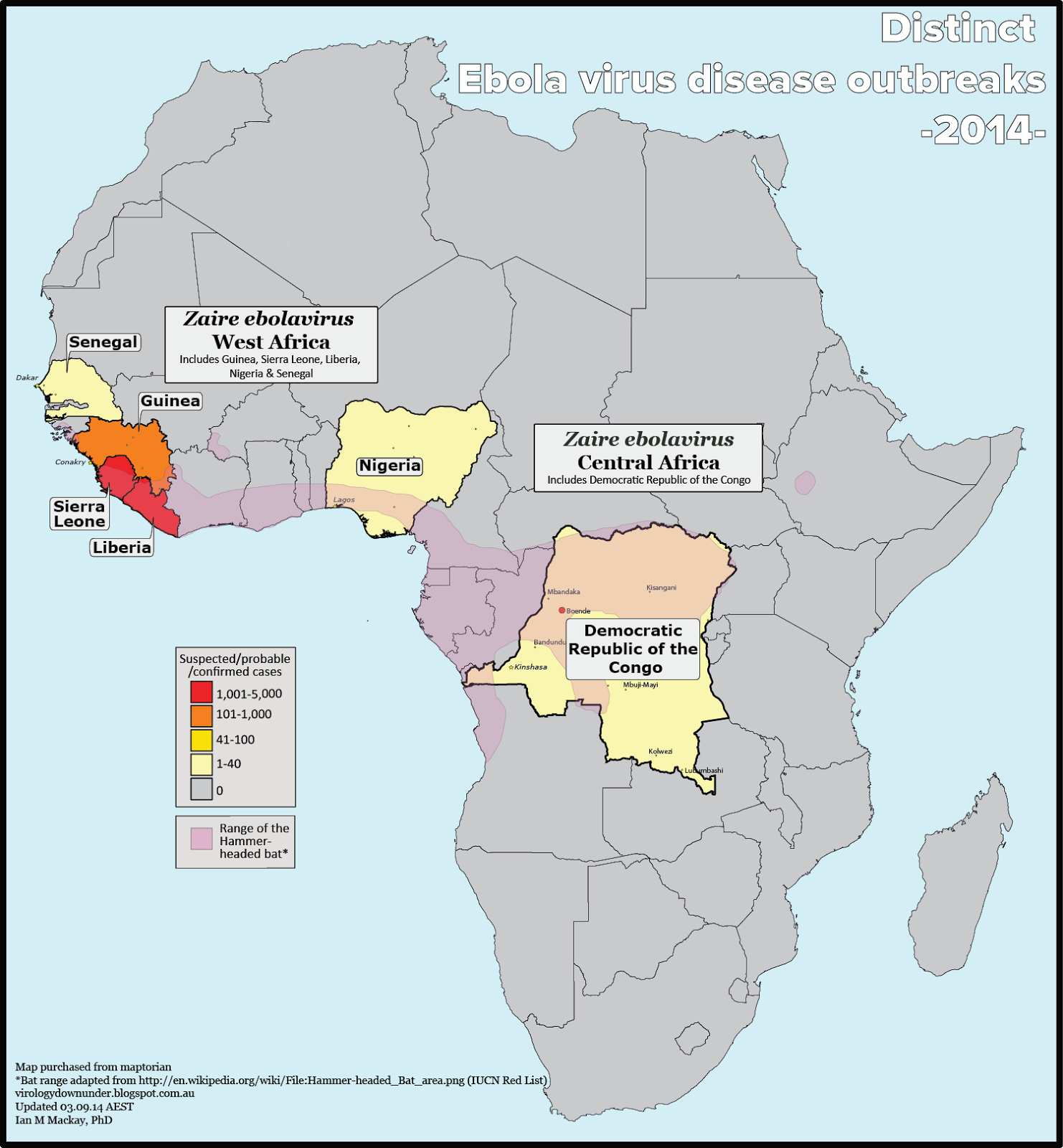
The outbreak of Ebola virus disease (EVD) began in December 2013 in Guinea. It spread to Sierra Leone, Liberia, Nigeria and Senegal. The last two countries on that list were able to contain EVD because they had functioning healthcare systems with doctors and nurses, protective equipment and hospitals that work. The United States of America (US) had its first imported cases arrive 30th September. To some extent, these final three countries could “see it coming”. None of these preparations were in place or possible in Guinea, Sierra Leone or Liberia. They are hosting the largest EVD outbreak in recorded history.

Help wanted.

On August 8th, this epidemic was labelled by the World Health Organization (WHO) as a Public Health Emergency of International Concern (PHEIC). The time for help to arrive and be effective is now. Before 70% of the predicted hundreds of thousands of cases to become infected by this variant of Zaire ebolavirus die. Money is required, and Australia has now donated eight million dollars. Three weeks ago a one billion dollar cost was forecast; a ten-fold increase in a month.[6] But what is really needed urgently are people. People to create beds through the building of treatment facilities, people to staff those facilities to provide the best supportive care possible under the circumstances, people to be trained to safely care for the sick and dying and to trains others, people to track cases, people to help educate family members in how to care for a sick loved one, people to help the psychologically traumatised try and deal with the loss of their children, their parents, siblings, cousins and friends. People are what’s needed. The United Nations (UN), which includes Australia, unanimously adopted Resolution 2177(2014) on the 18th of September within which it provided some instructions to member states. One of those is:
“8.   Urges Member States, as well as bilateral partners and multilateral organizations, including the AU, ECOWAS, and European Union, to mobilize and provide immediately technical expertise and additional medical capacity, including for rapid diagnosis and training of health workers at the national and international level, to the affected countries, and those providing assistance to the affected countries, and to continue to exchange expertise, lessons learned and best practices, as well as to maximize synergies to respond effectively and immediately to the Ebola outbreak, to provide essential resources, supplies and coordinated assistance to the affected countries and implementing partners and calls on all relevant actors to cooperate closely with the Secretary-General on response assistance efforts;”
Australian Prime Minster Tony Abbott noted to the UN that “We were one of the first countries to arrive with help in Japan after the 2011 earthquake; and in the Philippines after the 2013 typhoon.”[5] Why haven’t we arrived in West Africa yet?

Australian Foreign Minister Julie Bishop said on 29th of September, that Australia has not been specifically asked by the WHO to provide healthcare professionals to help.[2] But we a member state of the UN and the WHO is the United Nations’ public health arm. In that article the Minister was quoted as saying that we were unable to repatriate infected Australians safely, with this being an integral reason behind our limited response to the Resolution. 

Lightbulb Moment.

Until the Foreign Minister’s comment, the importance of the US concept of building a smaller, healthcare worker-specific treatment facility in West Africa was perhaps lost on the two of us. Such an elitist construction looked bad to the people of the region and, without sufficient background, to others outside it. However, if such a facility reduces or removes the need to spend tens to hundreds of thousands of dollars per person [3] to send them home for treatment, then it seems like a brilliant plan. That money could be better spent, and the added healthcare should help attract more international healthcare workers to the region. In fact, why doesn’t Australia assemble the components and airlift a similar facility, flat-packed, to one of the regions in need of our help? This could be done in a jiffy with Australian military precision. Once built, this facility may well remove the need to repatriate any Australian healthcare professional who may get infected. This may be a better and faster solution than us trying to use British or US facilities or doing a deal with them to evacuate our people. 

A good global citizen.

Prime Minister Abbott noted “That is what you’d expect from a country such as Australia which always wants to be the best global citizen”.[4] We are currently not being the best global citizens that we could be.

Let’s not hide behind excuses. Do we want our national character to be stingy and afraid or strong, generous and willing to give a fair go to those in need? We pride ourselves on our innovative character. We can use this to find a way around problems, real or perceived, in answering the UN’s call for help. Help we are able to provide. 

It would be difficult, heartbreaking, hard work. We know that Aussies are more than capable of doing that. In fact, the more people on the ground, helping, the easier the burden would be. There may be some problems, and it would be naive to expect otherwise. That is why the UN has called for help. If there were no risk, and everything was simple and easy, this situation would not exist in the first place. Should a healthcare worker fall ill, there is a high chance they would die. A tragedy for their family, friends and workmates. And let’s be real, there are more risks to healthcare workers than just Ebola virus disease in these countries. There are scared and sometimes violent villagers, as well as plenty of other diseases like malaria to contend with. 

The lucky country.

Australians have the wealth, the innovation, the ability, the equipment and the skills in our excellent health care workers, engineers, keepers of the peace and logistical organisers. We have the willing volunteers. 

How much of our global village has to burn down before we do more than buy a bucket? Why must we focus on security threats, economic impact, terrorism and political stability when it is the humanitarian aspects that should our priority? Yes, this seems to be the only way to communicate with politicians. But is the way forward for us as a nation that something has to be become a direct threat to us and our lucky country way of life before we lend a hand? Is that who we want to be? Can we not expect a more human perspective from our leaders and ourselves? We think we can. 

References

  1. http://www.who.int/mediacentre/news/statements/2014/ebola-20140808/en/
  2. http://www.theguardian.com/world/2014/sep/29/australia-cannot-bring-health-workers-home-from-african-ebola-zones
  3. http://www.cidrap.umn.edu/news-perspective/2014/09/very-few-aircraft-equipped-evacuate-ebola-patients
  4. http://www.news.com.au/national/medecins-sans-frontieres-slams-australias-ebola-response/story-fncynjr2-1227061379772
  5. http://www.pm.gov.au/media/2014-09-25/address-united-nations-general-assembly-united-nations-new-york
  6. http://www.unmultimedia.org/radio/english/2014/09/one-billion-dollars-needed-to-contain-ebola-outbreak/#.VCv3i_na6-0


Tuesday, September 30, 2014

The United States of America is the 6th country to host a 2014 West African Ebola virus variant..

v2 01102014 5:51pm AEST
First thing...
CALM DOWN!

This is the first case of Ebola virus infection to arrive in the United States that was not deliberately flown in. Its not the first viral haemorrhagic fever case though (1 case of Marburg virus disease and at least 4 Lassa virus infections and the Reston ebolavirus outbreak among imported animals[3,5]), and none of the earlier infections resulted in secondary transmission among humans; no-one else got infected from by the case.[4]
Countries that have hosted people infected
with the Ebola virus variant causing the
& 2014 West African Ebola virus
disease epidemic.
Click on image to enlarge.

The male is in critical condition.
When he flew from Liberia to the United States (finally arriving in Dallas,Texas). The man was not showing signs of disease when leaving Liberia or on the plane or immediately after arriving.[6]

This means that the man was not infectious - he could not spread it to fellow travellers or airport workers - because it is well known that disease in another does not develop due to virus being shed before disease is obvious in the infected person.

Briefly[1,2]:
  • 19th: Departed Liberia, checked and found to be symptom-free
  • 20th: Arrived in Dallas, US (connecting flights?)
  • 24th: Started to develop symptoms
  • 26th: Initially sought care
  • 28th: Admitted to hospital in Texas.
  • 30th: Texas public health laboratory found Ebola virus this morning of 30th Sept. CDC received samples, tested and confirmed as Ebola virus disease
  • Patient is ill and is under intensive care

US family and community contacts (a "handful") are known or being traced and will be under observation/monitoring for 21-days (~21-Oct) for fever. Will any become positive for Ebola virus? Perhaps. I look to Port Harcourt (Nigeria) for some comfort. There were around 60 "high risk" contacts of there and they did not all become ill.

So now we have evidence that supports all those talking heads (me included) who noted that it was possible for sporadic cases of EVD to be imported into countries outside of those in West Africa (Guinea, Liberia, Sierra Leone, Nigeria, Senegal). 

Soon, I very much believe, we will also have evidence that in richer countries with functioning healthcare systems, a good knowledge of what is needed to contain virus infections spread by all possible routes, stocks of the necessary personal protective equipment needed to protect healthcare workers from nosocomial infections and the training to use those stocks...to support that even when such cases arrive, they do not result in outbreaks.

References...
  1. https://www.youtube.com/watch?v=6Bxencye1cg&feature=youtu.be
  2. http://www.nytimes.com/2014/10/01/health/airline-passenger-with-ebola-is-under-treatment-in-dallas.html?partner=rss&emc=rss&smid=tw-nytimes
  3. http://scienceblogs.com/aetiology/2014/08/02/ebola-is-already-in-the-united-states/.
  4. http://blogs.scientificamerican.com/molecules-to-medicine/2014/09/30/ebola-in-usno-need-to-panic/?WT.mc_id=SA_sharetool_Twitter
  5. http://www.cdc.gov/media/releases/2014/s930-ebola-confirmed-case.html
  6. http://news.sciencemag.org/health/2014/09/one-more-ebola-question-dr-frieden-answers-journalists-would-have-first-u-s-case?rss=1

Monday, September 29, 2014

The numbers are underestimates...

Ebola virus numbers.

Sorry but D'uh - yes the numbers during the Ebola virus disease (EVD) outbreak happening since December in Guinea then progressing to Sierra Leone, Liberia, Nigeria and Senegal....are an underestimate. 

Of course they are! 

How could they possibly not be?

Have you not watched a single documentary or news video detailing how heartbreakingly difficult it is to visit and help the people of West Africa, to characterize and gather those case numbers, to take, transport and test samples?

The suspect cases are an underestimate. 
The probable cases are an under-estimate. 
The fatal cases are an under-estimate. 

The only thing that is spot on is the laboratory confirmation numbers, because they are what they were when someone wrote them down having had some semblance of control over the steps to acquire them. 

But let's put that underestimation into context. 

"The tip of the iceberg"
Image originally provided by Gregory Haertl, WHO.
Click to enlarge
Influenza case numbers each year are also an under-estimate. 

In fact, some of those, the subtyping numbers, are deliberately so because it's too expensive and wasteful to subtype every single laboratory confirmed case - so a sample of cases are tested and that is assumed to reflect the subtype distribution for that region during that period. 

But seasonal influenza case numbers as a whole are a huge underestimate. Influenza does not drive everyone to a general practitioner nor to a hospital. Some infections with influenza virus don't even produce noticeable symptoms at all. They are still infections. They just don't get counted. So influenza A virus, possibly the most tracked of any respiratory virus, is underestimates. And that's okay. 

Well, measles too, in the respiratory virus department. 

The latest big bad is the species D enterovirus 68 (EV-D68). But the paltry few detections of it (identified by genotyping) that have reported across the United States are likely a monstrous underestimate. In fact we have very little idea of a normal denominator for EV-D68 detections so it's hard to even know if 2014 is seeing all that big a change in its spread and distribution. Usually the enteroviruses (includes rhinoviruses) cause common cold-like illnesses and only get sought out in the great detail from a research point of view.

Middle East respiratory syndrome coronavirus (MERS-CoV) cases or the emerging influenza A(H7N9) virus cases are all underestimated as well. 

The population of your state or country is an underestimate too you know?

This is because we cannot capture every single case of infection, or person, at once. 

So the next time you are about to say "the WHO numbers are an underestimate" as if that is a revelation or an unexpectedly horrible thing you can also lay at their doorstep - please just don't. It's not smart, new or unusual.

You might as well say the world is round; underestimation of infection numbers is just that well established a fact. It's just by how much, and frankly that doesn't even matter too much because the trends can usually be easily seen, or quickly extrapolated.

Perhaps you did not know all that before. But if you have read to here, you do now.

The control gap...

v2 300914
I have a theory.

This theory is meant only to apply to disease outbreak/epidemic/pandemic situations, and then only to those which include fatal cases.

This theory of mine has only emerged since I've been plotting Ebola virus cases numbers from the West African epidemic. I precede the explanation with the caveat that there is very probably already a well developed, well-known actual epidemiology term to describe this theory. But I'm not a trained epidemiologist and this is just a blog, so please forgive me my ignorance.

The theory goes that when a gap grows between the number of new cases being reported and the number of deaths or laboratory confirmations in that population, despite the outbreak having been going for a while, this represents an indication that control of the situation is slipping, or has been lost. 

Mind the gap.

This "control gap" - my term, so don't expect to find it anywhere official or that knows of that which it speaks - can also appear when looking at suspected or probable cases of disease X, and the number of those that have been confirmed by a laboratory test.

Other explanations for the control gap may exist of course; testing may be scaled back deliberately, reporting of deaths may have been deliberately throttled for some political reason. So it may not reflect being "out of control" as much as someone else being "in control".

Probably still more variations that I have not thought of at all.

Ebola virus disease (EVD) in Liberia.

In the graphics below I've used the accumulation of World Health Organization data for Liberia, up to 23-Sept. 

First up - the fold increase in total case numbers (suspect+probable+laboratory confirmed) compared to the fold-increase in the distance between that total and the total number of laboratory confirmed cases alone. This distance, or the "control gap|lab", has widened over time. It has widened because total cases have climbed more steeply than the number given a laboratory confirmed diagnosis of EVD. 

For whatever reason(s), laboratory confirmations are not keeping pace with the total case numbers, and they seemed to start slipping at the end of July. 

I suspect a principal reason - and I'm not on the ground of course, so this is all speculation and second-hand knowledge - is that laboratory capacity is overwhelmed. 

Other reasons include that samples might not always be collected or that many recent clinically defined EVD cases are actually due to something clinically similar to EVD, but not an Ebola virus infection. If it were this last one though, the total numbers would be readjusted downwards as new diagnoses were made...if the laboratory has time to make those of course...so I doubt it as a major role.

The control gap|lab
A.) Ebola virus disease case graph for Liberia showing the accumulation of total (suspect+probable+laboratory confirmed) cases (pink line; left y-axis) and deaths (blue line; left y-axis), the laboratory confirmations (green line; left y-axis) and the proportion of fatal cases (right y-axis) at each reporting date (x-axis). The size of the gap between laboratory confirmed cases and total cases is indicated for a range of reporting dates, using a vertical green drop-line.

B.) The drop-lines have been copied and aligned and the amount they have grown has been measured using a scale bar so that the fold-increase can be compared to the first reporting date used, 8-July. The fold-increase value is written at the top of each drop-line. Along the bottom (enclosed within a grey box) are the case numbers at each reporting date examined and the fold-increase (in bold) compared to the 8-July baseline.


Next up -the fold increase in total case numbers (suspect+probable+laboratory confirmed) compared to the fold-increase in the distance between that total and the total number of deaths. The control gap|deaths comparison finds that the deaths and the total cases don't diverge as much as total cases and lab confirmations do. 


The control gap|deaths
A.) Ebola virus disease case graph for Liberia showing the accumulation of total (suspect+probable+laboratory confirmed) cases (pink line; left y-axis) and deaths (blue line; left y-axis), the laboratory confirmations (green line; left y-axis) and the proportion of fatal cases (right y-axis) at each reporting date (x-axis). The size of the gap between laboratory confirmed cases and deaths is indicated for a range of reporting dates, using a vertical blue drop-line.

B.) The drop-lines have been copied and aligned and the amount they have grown has been measured using a scale bar so that the fold-increase can be compared to the first reporting date used, 8-July. The fold-increase value is written at the top of each drop-line. Along the bottom (enclosed within a grey box) are the number of deaths at each reporting date examined and the fold-increase (in bold) compared to the 8-July baseline.

So with that visualization under our belt, there is another, less laborious way to look at this, by graphing the numbers, rather than the gaps.

What we see when we plot the fold-change values against report date is that total cases lost control as we suspected, but deaths are less obviously out of control. From 9-Sept onwards the gap has widened a little more consistently. Before that though the deaths did not dramatically drift away from the rate at which new cases were being added.

I'll graph Sierra Leone, Guinea and Nigeria in the next day or two. Nigeria should serve as an example of how this looks for a country in which EVD is definitely in control. 


Graphing the control gaps


Wednesday, September 17, 2014

Updating a model of a modern Ebola epidemic...

Professor David Fisman, University of Toronto, Canada published one of the excellent recent models designed to estimate where Ebola virus disease case numbers might be heading.[1] He has updated his model using the latest World Health Organization EVD data that includes up to 13-Sept.

This morning I awoke to find the fruits of his labour generously presented to the world via Twitter.

I'm constantly impressed by how much info can and is being provided for everyone to share, discuss and  constructively mull over. This is just the latest fantastic effort.


Prof Fisman's (@DavidFisman) model has provided a very close estimate when compared to the real figures on which it is, of course, based (Figure 1.). His estimates have not changed with the latest data. He calculates an overall R0 of 1.75, and 'd' (a value that can indicate the level of control; when d is zero, you have uncontrolled exponential growth) is at 0.0078. The d values for different countries in the outbreak, differ.

Figure 1. Showing that the model (black line) fits extremely well
to actual reported case numbers (red bars) to date
The projected end date is November 2016 with a final size of approximately 480,000 cases. (Figure 2) This is just based on current numbers and without knowing what interventions are coming not how successful they will be. Prof Fisman says his model currently predicts an epidemic peak in June-2015 at which time there could be 227,000 cases. By Jan-2015, projected case counts reach 28,450.

Figure 2. Extending the model into 2017.
Red curve (right y-axis): incidence by 15-day generation.
Blue curve (left y-axis): cumulative cases.
Keeping in mind that these numbers do not include deaths. The proportion of fatal cases (PFC) requires some further mathematical wizardry in order to account for the time between when cases present to a treatment facility, and when they die. 


Figure 3. Ebola virus disease cumulative curve for Nigeria.
The proportion of fatal cases is markedly lower than for
 the more overwhelmed countries. This does
not appear to be an artefact as most cases have
been laboratory confirmed.
It's not a simple division of deaths and total cases at the same time point (these are the crude percentages I report on VDU and which the WHO report-this reporting may change in the future). 

The addition of that calculation spikes the PFC to >80% at times (see the post by @maiamajumder post on HealthMap), but seems to vary to lower figures depending on country and population for example, in Nigeria (Figure 3). But whatever way you look at it, many people will die from Ebola virus infection, as well as all the other diseases and medical care needs that going with sufficient attention.

References..

  1. Early Epidemic Dynamics of the West African 2014 Ebola Outbreak: Estimates Derived with a Simple Two-Parameter Model
    http://currents.plos.org/outbreaks/article/obk-14-0036-early-epidemic-dynamics-of-the-west-african-2014-ebola-outbreak-estimates-derived-with-a-simple-two-parameter-model/


Friday, September 12, 2014

The wind beneath my Ebola virus.... [UPDATED]

Only a couple of weeks ago the report in Science presented 99 genomes representing some of the thousands of those circulating in Sierra Leone this year.[1] I say thousands because each infected person has a range of subtley different viral variants among the billions of viruses per millilitre of blood that all compete to be the champion. The words "mutant" and "ebolavirus" are now hard to avoid. And of course as soon as you talk mutations, you can only see one endgame - a virus that is easily transmissible and turns us all into zombies. spreads across the world in a pandemic and kills as many as 80% of those it infects. Yes, its seems the proportion of fatal cases (PFC) in West Africa may not be as simply calculated as most of us were thinking these past months. When we take into account that Ebola virus disease deaths occur in people that were part of a case tally days earlier (if they were counted of course) when the total case numbers were smaller, the PFC inflates. How much, we don't really know.

And so the story of mutants was brought full circle today thanks to Dr. Michael T. Osterholm. In a very nicely written piece for the New York Times,[2] Dr. Osterholm, ventured behind the scenes to crack the door into the world of whispered discussions, shadowy frappé meetings by chino and beige blazer-wearing figures, many of whom were men with with thinning hair. Yes, he found where the real virologists hang out and what were they discussing at length? Why they were talking about how soon it would be until Zaire ebolavirus was going to mutate and become an airborne killer virus identifiable only through watching big wall-mounted LCD screens as they are rendered in red because of the fusion of rapidly growing dots, spreading across a map of a world filling rapidly with infected hosts. Or red dots. Or something. Okay, some of that was from me.


Only problem is, I think he may have entered the tinfoil hat room next door to the (but very similarly attired) room full of virologists. Maybe not. Hard to tell sometimes. But seriously.


For sure, a virus changes over time. It will change randomly through mutations that happen because viruses, especially those with genes/a genome made of RNA, are always making errors in their gene/genome copying and sometimes those errors make the virus better at something. Viruses may hold on to those changes in response to all sorts of pressures on them. These genetic sequence changes sometimes results in change to the proteins that make their structures and enzymes. Sometimes the changes may revert back as pressures go away or new ones come to be. It's a constant micro-environment of change; evolution on fast forward.


We should also keep in mind ebolaviruses didn't come down in the last shower. They are viruses that are happy in their own envelopes...and natural host(s). But mutational changes can impact on how the viral "bits" assemble and release from the cell and perhaps on how the virus causes disease, where virus replicates in the body, how it interferes with the host immune system's attempts to interfere with it, how hardy it is, how well it replicates in response to temperature and so on. 


A virus doesn't "think" about any this of course. It doesn't plan to do the nastiest thing to us that we can imagine when it jumps into us from an animal (a zoonosis). Headlines might make you think otherwise. These changes happen because, in a new host species producing many subtley different viral variants all vying for supremacy, the virus with the mutation(s) that allow it to get out from under some sort of controlling pressure or to do something better than the earlier viral versions, wins the day. The winner thrives, makes more of itself or does it better, and passes to new hosts.


A virus may keep more of these mutational changes while it is "settling in" to a new animal host species if they help that process. It may be under more pressure to adapt to slightly different environments, different receptor structures, temperatures, immune responses - all sorts of things may created a different environment from the one the virus came from and so it may need to make use of more mutations in order to "find its footing". Or fail and not find a home in the new host.


There can be all sorts of new and negative pressures to try and avoid or adapt to for a virus. So ebolaviruses seem to naturally infect bats, not us, and in bats the infection does not seem to cause a whole lot of disease. Of course we don't know a whole lot about how bats spread virus among themselves. Perhaps they do it via an airborne route. The theory then goes that humans or other forest animals including chimpanzees, gorillas, porcupines and antelopes may eat the bats or bat/virus-contaminated fruit. We, and those animals, do get sick.


Another unsure thing, a sizable knowledge gap you might call it, is whether an ebolavirus would actually be under any pressure at all to keep the mutations that change its proteins, site of replication and disease course which result in it being:

  • More stable in dried droplets
  • Shed in higher concentrations from the upper respiratory tract
  • Able to trigger more coughing or sneezing.
Each and all of these major changes might be necessary to create the mythical airborne Ebola virus. The outcome? Creation and propulsion of more droplets from an infected human, that dry down and linger in the air (the airborne part) while still containing infectious ebolavirus, and enough of it to result in human infection and disease. Phew. That is an unbelievable series of huge changes, even for a "sloppy" replicating RNA virus. 

I think we all understand that a virus doesn't "know" that these changes would provide better spreading outcomes and we now know that Ebola virus already spreads very well between bats and in humans (see the West Africa outbreak numbers which have not at any time been linked to a different or unusual spread of virus compared to any earlier outbreak[11]). To date, airborne spread has never been found to happen naturally in the dissemination of Ebola virus disease in humans. That is some kind of significant considering it does not take a lot of virus to start an infection through direct contact and considering there have been non-human primate transmission chains in the forests for a long time.

Each of those changes to the virus and the host's disease might happen by a series of accumulating mutations over time. But is their pressure to keep each of them? And really to be airborne, these changes would need to co-occur and do so without any trade-offs that meant the 'new airborne virus' was negatively impacted in some other area of its attachment, cell entry, replication, interference with the immune response enzymatic efficiencies etc. 


We do already know that in the lab, under laboratory conditions, with lab animals, lab equipment, plenty of lab-grown virus and a closed space with a lot of aerosol (probably some of which is wet droplets, not just droplet nuclei, meaning not truly airborne conditions), an Ebola virus can be forced to infect non-human primates. I've written about that previously.[3] 


And yet even when it was sought, no sign of such airborne infection has been found to occur naturally among humans. Direct. Contact. 


So I think it was a stretch to expend so many words on the chances of an airborne virus emerging rather than one that causes more bleeding, or less diarrhoea, or more vomiting, or more shedding in sweat, or having lower viral loads, more rash, more hiccups etc. 

Many additional things could result from mutational changes. We know next to nothing about the mutations recorded from the 99 genomes in Sierra Leone.[1] So why all this focus on one specific yet really quite complex outcome of viral air travel instead of many/any others? I don't know. But hey, now we have indeed been able to talk about this aspect some more, so good one Dr O! 


Others have come out to comment too. 


  • Dr Anthony Fauci, director of the National Institute of Allergy and Infectious Diseases in the US noted that "it’s fundamentally unlikely"[9]
  • Dr Amesh Adalja, University Pittsburgh said "it may not be the best path for the virus to take"[10]
  • Dr Derek Gatherer of Lancaster University in the UK noted an airborne Ebola virus would need a "conjunction of coincidental, unlikely events" [10] 

  • Dr David Heymann, Chair of the Health Protection Agency in the UK stated "No one can predict what will happen with the mutation of the virus", reminding us that "The virus's epidemiology is consistent with transmission via bodily secretions and excretions, which is exactly the same as other past epidemics".[11]
  • Prof Vincent Racaniello, a virologist at the College of Physicians and Surgeons at Columbia University stated "We have been studying viruses for over 100 years, and we've never seen a human virus change the way it is transmitted."[12]

Dr Osterholm did hit some other nails flush with the timber though. West Africa needs fewer promises to defeat Ebola virus and more plans that include actual rapid mobilization and on the ground experienced leadership to make inroads into getting beds for sick people and tracing contacts. Two key items on a long list of things to do better (in my opinion).

Thankfully some promising signs are appearing. The scope of this outbreak has now been guesstimated - 20k-100k cases.[4,5,6,7] I list this range rather than extending it to much higher levels [8] because I do still have hope that things will improve and interventions will turn the exponential case growth curves away from the sky and back to the horizon, sooner rather than before entire nations are destroyed. Because that's what is coming without successful intervention.


Money is being freed up and arriving from all over and more resources are slowly moving in to the region. Resources needed just to keep the people safe who have come from all over the world, including the nations of Africa, to care for the overwhelming numbers of sick and sickening people. Not to mention the money needed to prevent more infections. More specific and insistent pleas for defined numbers of healthcare professionals are also being broadcast. Drugs and vaccines are closer than they have ever been to use in humans. They may be our only hope to stop this virus.


If the many thousands of people predicted to die from a virus that is killing 4 in 5 confirmed cases (see the Medicins Sans Frontieres tweet below) is not enough reason for stopping the spread of Ebola virus, then stopping this particular evolving variant before it does change into something worse or more ingrained to the communities all over Africa and beyond, really is. 


While this Ebola virus variant may never make the changes necessary for it to go airborne, it has shown signs of relatively rapid change and that was relatively early in what looks to be a very long chain of human-to-human-to-human-to-human... transmission. Each person allowing the virus to adapt further, if that's what it needs to do.


Such a long transmission chain, from 1 animal>human infection, has never been recorded before and so we are indeed in new territory when it comes to the ebolaviruses. For now at least, the Ebola virus in 5 countries in and around West Africa has the upper hand. This tiny self-assembling unthinking, randomly mutating thing is totally dependent on our cells to replicate itself - and we are not doing enough to starve it of those cells. 


It clearly doesn't "need" to be airborne to spread efficiently.


References...
  1. http://www.sciencemag.org/content/345/6202/1369
  2. http://www.nytimes.com/2014/09/12/opinion/what-were-afraid-to-say-about-ebola.html?smid=tw-share
  3. http://virologydownunder.blogspot.com.au/2014/08/ebola-pigs-primates-and-people.html
  4. http://currents.plos.org/outbreaks/article/estimating-the-reproduction-number-of-zaire-ebolavirus-ebov-during-the-2014-outbreak-in-west-africa/
  5. http://currents.plos.org/outbreaks/article/obk-14-0036-early-epidemic-dynamics-of-the-west-african-2014-ebola-outbreak-estimates-derived-with-a-simple-two-parameter-model/
  6. http://healthintelligence.drupalgardens.com/content/predicting-number-cases-ebola-virus-disease-outbreak-countries-widespread-and-intense
  7. http://news.sciencemag.org/health/2014/08/disease-modelers-project-rapidly-rising-toll-ebola
  8. http://www.dw.de/ebola-threatens-to-destroy-sierra-leone-and-liberia/a-17915090
  9. http://time.com/3342305/airbone-ebola-not-happening/
  10. http://news.yahoo.com/could-ebola-become-airborne-153701091.html
  11. http://www.dailymail.co.uk/health/article-2753421/Real-risk-Ebola-virus-mutate-AIRBORNE-disease-expert-warns.html
  12. http://www.vox.com/2014/9/19/6543157/ebola-is-unlikely-to-go-airborne